Introduction
The monoamines are neurotransmitters that contain one amino group that is connected to an aromatic ring by a two-carbon chain (-CH2-CH2-). Typically, the monoamines activate G proteins to exert their effects at the synapse, although there is one exception described below.
Monoaminergic systems, the networks of neurons that utilize monoamine neurotransmitters, are involved in the regulation of cognitive processes such as emotion, arousal, and certain types of memory.
The monoamines are normally separated into three groups:
| Group | Characteristics | Members |
|---|---|---|
| Histamine | Derived from decarboxylation of the amino acid histidine | Histamine |
| Catecholamines | Have a catechol (benzene with two hydroxyl side groups at carbons 1 and 2) and a side-chain amine | Epinephrine, Dopamine, Norepinephrine |
| Tryptamines | Contain an indole ring structure, so structurally similar to the amino acid tryptophan | Serotonin, Melatonin |
All of the molecules listed above are used as neurotransmitters by the central nervous system, but we will focus on the following three with the most important roles: dopamine, norepinephrine, and serotonin.
All of the monoamines are reuptaken into the presynaptic nerve terminal through monoamine transporters. Each of the monoamines we will focus on has its own transporter, but since dopamine and norepinephrine are similar molecules, the norepinephrine transporter can reuptake dopamine, and vice versa. Many drugs used to treat mental health disorders, as well as recreational drugs such as cocaine, have their actions on the monoamine transporters. For example, most modern antidepressant drugs work on the principal of blocking these re-uptake transporters.
There are many, many subtypes of monoamine receptors, and thus we will only focus on generalities. These receptors are both presynaptic and postsynaptic.
Serotonin
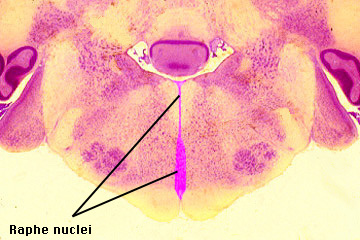
Serotonin-producing neurons are located in the raphe nuclei of the brainstem. These neurons project diffusely throughout the nervous system; their axons branch extensively to have synaptic connections with many postsynaptic neurons.
Serotonin (also called 5-hydroxytryptamine or 5HT) binds to many subtypes of receptors that are distributed in the cerebral cortex, limbic system, and spinal cord. Except for one receptor subtype (5HT3), all serotonin receptors are metabotropic.
Abnormal serotonin levels have been implicated in a number of psychiatric and neurological disorders, including depression, generalized anxiety disorder, migraines and others. Serotonin also plays a role in modulating pain. Many drugs target serotonergic neurotransmission, including SSRIs (Selective Serotonin Reuptake Inhibitors) such as Prozac, which is used to treat depression.
Norepinephrine
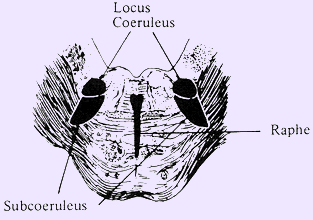
Norepinephrine is synthesized by most sympathetic postganglionic neurons as well as groups of neurons in the brainstem whose axons branch extensively. The largest of the norepinephrine-producing cell groups is located in a nucleus in the pons called locus coeruleus. Locus coeruleus neurons contain melanin crystals, such that the nucleus appears as a black dot in brainstem sections through the pons.
Norepinephrine binds to two main subtypes of metabotropic receptors: α and β. The α subtype can be divided into the α-1 and α-2 subtypes. The β subtype can be divided into β-1, β-2 and β-3 receptors, although β-3 receptors are mainly in peripheral tissues (not the CNS) and are less important than the other subclasses.
The actions of norepinephrine binding to these receptors is summarized in the table below:
| Receptor | Effects of binding to the receptor |
|---|---|
| α1 | Activates phospholipase C, resulting in an increase in intracellular Ca2+ |
| α2 | Decreases cAMP by inhibiting adenylate cyclase |
| β (all subtypes) | Increases cAMP by activating adenylate cyclase |
Based on this information, it appears that binding of ligand to α2 and β receptors would have opposite effects. While it is true that effects of transmitter binding to α1 and β receptors produces excitatory responses, whereas binding of norepinephrine to α2 causes inhibitory responses, there is a complication. In the central nervous system, α2 receptors are mostly presynaptic autoreceptors, such that ligand binding to the receptor reduces norepinephrine release from the nerve terminal. In contrast, α1 and β receptors are usually postsynaptic.
Dopamine
Dopamine is mainly a neurotransmitter of the central nervous system, although some peripheral tissues (e.g., cells in the kidney) also use dopamine as a signaling molecule. There are 5 main subtypes of dopamine receptors (D1-D5), all of which exert their effects by activating G-proteins. Most dopamine receptors are postsynaptic, but some are presynaptic (autoreceptors).
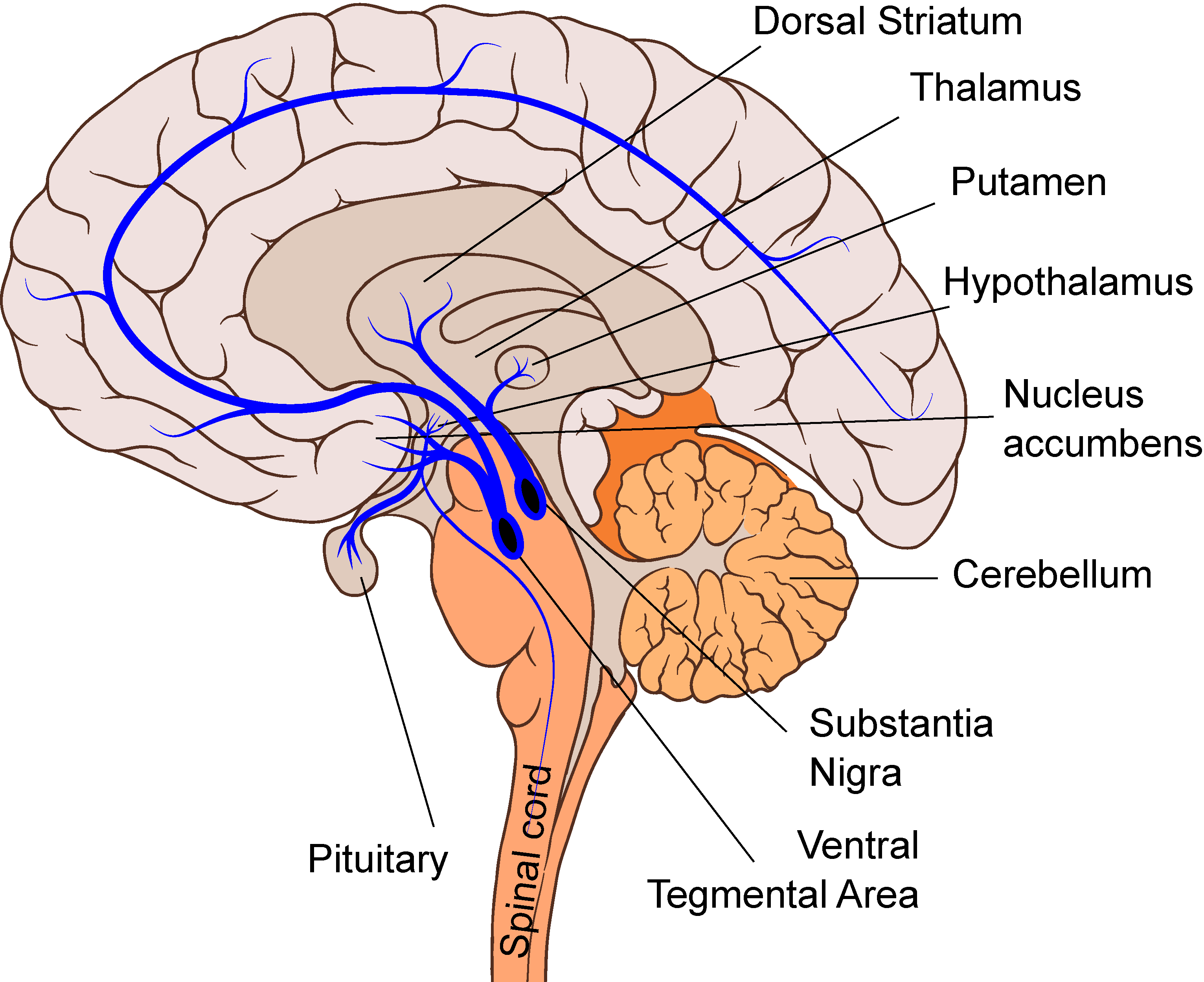
Most dopaminergic neurons are located in two midbrain areas, substantia nigra pars compacta and the ventral tegmental area.
Neurons in substantia nigra pars compacta project to regions of the basal ganglia called the striatum, parts of the brain that are involved in movement control. Degeneration of these connections (nigro-striatal pathway) results in Parkinson's disease. These connections will be discussed during the second week of the class.
Dopamine-producing neurons in the ventral tegmental area project to prefrontal cortex, and structures of the limbic system. These connections are a fundamental part of the brain's reward system, and also have roles in cognition. Changes in dopaminergic transmission in this pathway can result in psychiatric diseases, including schizophrenia and attention deficit hyperactivity disorder. These connections will be discussed during this course, and in the psychiatry course.
Summation
Now that we have discussed a bunch of neurotransmitters, let's review what they do by watching a movie from the KhanAcademy.
If the movie does not play in this window, or you would like to see it in a window of alternate size, download it from this link.